
 by Serena Jayne
The rebirth of the earth during spring signals the opportunity for new beginnings. Spring is the epitome of a juice cleanse after scarfing down an entire box of Girl Scout cookies. Spring cleaning allows people to shed their hoarder habits, and finally locate their lucky socks. There’s no better time than spring to take an inventory of one’s life, and use the fresh start to focus on what truly matters.
Charles Prendergast’s painting “Untitled (Rites of Spring),” which is a part of the Art Institute of Chicago’s collection, shows a number of maidens frolicking in celebration of the season. The gold and silver leaf makes the scene sparkle and shine. Even the birds look happy. Spring is not only in the air, but in the minds and hearts of every joyful creature depicted.

The seasons progress much like the triple goddess expressed as maiden, mother, and crone. Spring is the fresh-faced maiden, unspoiled and full of opportunity. Summer becomes the mother, whose energy is shifted to her kiddies who keep her busy chasing rainbows and unicorn dreams under a sunny sky. Fall and winter symbolize the crone, who brings wisdom and sometimes icy regret, a far cry from the promise and hope of spring.
In Greek Mythology, Hades abducts a maiden named Persephone and takes her to his home in the Underworld. Her mother Demeter, the goddess of agriculture among other things, expresses her grief over the loss of her daughter by making the earth barren.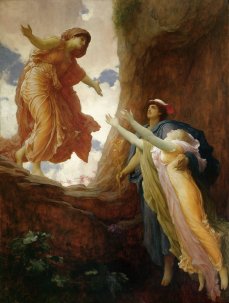 Persephone’s return from the Underworld is arranged, but because of the pomegranate seeds she’d consumed there, Hades maintains a hold on her. A kind of shared custody agreement is struck, where she splits her time between Earth and the Underworld. When mother and daughter are reunited, Demeter’s icy exterior melts bringing spring. The Earth remains fertile until Persephone’s return to the Underworld come fall.
The myth of Persephone and Demeter demonstrates a new beginning. The mother-daughter relationship is ever changed by Persephone’s abduction and her seasonal return to Earth. Demeter is forced to see her daughter, not as a child, but as a woman. Absence may make the heart grow fonder. A reunion with what was once lost brings a new appreciation and gratitude. The requirement to share her daughter with Hades makes each moment with Persephone a little more special—a little more precious. Something perhaps previously taken for granted is now cherished.
In his book, The Subtle Art of Not Giving a F*ck: A Counterintuitive Approach to Living a Good Life, Mark Manson encourages the reader to restrict her time and energy to the people and things that truly matter in life. Change generated by unsolicited self-evaluation beats regret, because as magical as spring may be, second chances aren’t a guarantee. Time trudges ever forward. If one fails to take advantage of the renewal spring offers, soon it’s time to pull out the boots, puffy coats, and snow shovels, and opportunities turn to might-have-beens.
 Use spring to jump start positive change. Decide where best to channel time and energy. Make plans with friends and family. Dust off that To-Do list. Prioritize To-Be-Read lists and bucket lists or simply decide who and what matters most, and adjust time and energy accordingly. If things don’t go as expected, don’t worry. Persephone will be back for a return engagement bringing the gift of another opportunity for a fresh start and a bright future. Plan accordingly.


 the battlefield. Goddess of the flame, and goddess of the well. Goddess of those who create, and goddess of those who destroy. It’s almost as though there is no end to her multi-faceted being. In some versions of the legend, she is a three-part goddess, and each part represents a different aspect of her nature. Her wisdom is the seed for all else; it allows her to understand, to empathize, to learn, to seek, and to do.
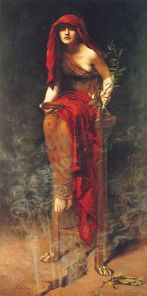 She stands close to associations with the Earth, the musty damp womb of the dirt where decay and birth exist simultaneously. You can find her only after a journey, you can hope she will proclaim that you are destined for greatness or give clarity for your decisions, but she may also give omens of dread, of doom or mere unsatisfying riddles. Whatever she utters, for ill or good, are the words of divinity.
 Read the great mythologies of Ancient Greece and you will encounter over and over the Oracle at Delphi, the Pythia. She dwelled at a place that must have seemed to the ancients was the opening to the womb of the Earth itself, a seam from which the vapors arose giving the Pythia the power of prophesy. Her words can be found in many sources from the ancient world. But there’s so much more to the existence of the Pythia that captures my imagination, it is what she represents—a remnant of even older belief systems.
 The serpent brings instinctive fear. In the Judeo-Christian tradition, it is the Devil, in the form of a serpent who tempts Eve, who, along with Adam are cast out from the Garden of Eden as punishment. The Medusa of Ancient Greek mythology with her head writhing with nest of serpents could turn a man to stone. Early civilization abounds with the association of women with serpents, something that continues into the Ancient Greek world. The very title “Pythia,” is a reference to the
 great Python, the serpent beast who originally guarded the Delphi site.
 “Then Phoebus Apollo boasted over her (Python): Now rot here upon the soil that feeds man! You at least shall live no more to be a fell bane to men who eat the fruit of the all-nourishing earth…but here shall the Earth and shining Hyperion make you rot.”
![Pythia Aegeus Themis Delphi[1]](https://cannotbecontainedcom.files.wordpress.com/2017/10/pythia-aegeus-themis-delphi1.jpg?w=334&h=290) exerted considerable control over the oracles that she delivered,” and that while male priests existed they did not perform as oracles and further were not the ones who were the subject of attempted bribery.
exerted considerable control over the oracles that she delivered,” and that while male priests existed they did not perform as oracles and further were not the ones who were the subject of attempted bribery.


 King Cleomenes managed to get himself to the acropolis, the central and most important part of the ancient Athenian polis, also the location of the holy temple of Athena. Weary and looking for a moment of spiritual reflection, Cleomenes, King of Sparta enters to the holiest place in the city of Athens, to pray. I imagine he opened the temple door, ready to step into the welcome cool dim within when he heard an angry female voice. An angry and powerful female voice, accustomed to being obeyed.
 oracular visions of the coming of Jesus Christ and the ultimate establishment of Christendom. Yet it is interesting to note that Christians of this age viewed the prophesy of the Cumae Sibyl as a frightening example of female paganism. This is a fascinating conflict, despite rejecting paganism itself, they acknowledged the power of the female prophetess. Christian scholars were convinced that Sibyl, by divine power, had foreseen the birth of Jesus and through extension rejected Roman pagan authority.“By Destiny’s unalterable decree. Assume thy greatness, for the time draws night, Dear child of gods, great progeny of Jove!”2 While the Sibyl represented a pagan belief system, medieval scholars recognized that she held a special power, especially if she foresaw the coming of their Lord.
 sacred womanhood is not to be underestimated. This is reflected in the very stories of the divine, contained with the feminine— a sacred looming power.
 “At your battle-cry, my lady, the foreign lands bow low. When humanity comes before you in awed silence at the terrifying radiance and tempest, you grasp the most terrible of all the divine powers. Because of you, the threshold of tears is opened, and people walk along the path of the house of great lamentations. In the van of battle, all is struck down before you. With your strength, my lady, teeth can crush flint. You charge forward like a charging storm.
  Unbound