
The daughter of a king, the sister of a king, the wife of a king, Marguerite de Navarre was by virtue of her parentage and offspring, one of the most notable women of the 16th century, but in character and accomplishments, she was far more than the inheritor and ancestor of great European dynasties. A queen, author, intellectual, diplomat, polyglot, patron of the arts, and humanist, Marguerite’s abilities challenged and transcended the social expectations of a noble woman of her time, and in so doing presaged the changing roles of women in the realm of intellectual pursuits.
One might say that, gender pronouns notwithstanding, Marguerite de Navarre was the archetypal “Renaissance Man.” Though born at a time when even the most talented women were unlikely to be recognized for their artistic and intellectual contributions, history remembers her not only for her hereditary place in the history of European royalty, but for her art, and for the support and protection that she provided for some of the great other great thinkers and artists of the Renaissance.
Born to the heir to the French throne (and the sister to the future King Francis I), Marguerite was connected to some of the most important people and events of the 16th century. Though she was given an excellent education, as a member of the famous and prestigious House of Valois, she began her adult life just as many noble women of her time–as a diplomatic chip to be bartered in marriage.
 Historically speaking, she dodged a bullet when negotiations failed that would have her marry England’s Prince of Wales, who would go on to rule as King (and serial wife-decapitator) Henry VIII. Instead, she was married to the Duke of Alençon, who was captured (along with her brother Francis I, and future husband Henry II of Navarre) during the French debacle at the battle of Pavia in 1525 and died not long after. According to accounts Marguerite, a notable diplomat in her own right, rode day and night into Spanish territory to secure her brother’s release.
After being widowed, Marguerite, still a young woman, was married to Henry II of Navarre. Henry was in many ways a king in name only, as most of his kingdom had been absorbed by Ferdinand II of Aragon over twenty years prior. Still, her marriage to a wealthy and well-connected nobleman afforded an opportunity to devote herself to her passions of art and learning. Her renowned salon, dubbed “New Parnassus” was famous across Europe, and Marguerite hosted and corresponded with some of the most notable thinkers of her day, including Leonardo da Vinci and Desiderius Erasmus.
Marguerite was a devoted humanist, and was the patron to many Renaissance artists and figures of the reformation, providing protection for artists and thinkers that might otherwise have been suppressed or persecuted in other, less tolerant realms. Notably, under Marguerite’s protection, François Rabelais wrote the controversial Gargantua and Pantagruel, the third book of which is dedicated to the Queen of Navarre.
 Though her first marriage was childless, Marguerite’s lone surviving child would go on to cement important place in history. Her daughter Jeanne III was an important figure in the Huguenot movement, and the mother of Henry IV of France, the first of the Bourbon line of French kings. The loss of her only son as an infant is often suggested to be the inspiration for her controversial poem Miroir de l’âme pécheresse (“The Mirror of the Sinful Soul”), a devotional and personal work that caused outrage in some religious circles.
Ironically, for all Marguerite accomplished as a patron and artist in her lifetime, the unfinished Heptaméron is often considered the best, and certainly the most well-known, of her work. Written in the style of Bocaccio’s Decameron (whom Marguerite greatly admired), the book is a collection of short stories linked with a framing narrative. Originally planned to be a collection of ten stories per day over ten days (in the style of Bocaccio), Marguerite’s death in 1549 left the book unfinished with only 73 entries.
For a modern observer, what Marguerite de Navarre accomplished was nothing short of stunning. Not only did she create an artistic and intellectual legacy for herself, and foster  the development of countless Renaissance artists, she did so while somehow maintaining her own reputation in her own era. History is littered with woman of talent and drive who succeeded only in retrospect, who are appreciated only posthumously for their contributions, and in their own time ignored or even scored for the audacity to aspire to “men’s work.” Marguerite was a unique artifact of history; she was the personal embodiment of arts and intellectual endeavors, who perfectly reflected the changing face of Western society. Her direct and indirect contributions to the arts, religious discourse, and humanist thought earn her a well-deserved reputation as the first “modern woman,” and heralded the rise of women authors and scholars that came after her.
Works Cited
“Biography of Marguerite de Navarre, author of the Heptameron.” Heptameron.info, 30 July, 2017. http://www.heptameron.info/navarre.html.
Fabbri, Kimberly. Marguerite, Queen of Navarre. Kings College, Dec. 2005, http://departments.kings.edu/womens_history/margueritN.html.
“Marguerite de Navarre.” Poetry Foundation, 30 July, 2017. https://www.poetryfoundation.org/poets/marguerite-de-navarre.
 Just History Posts
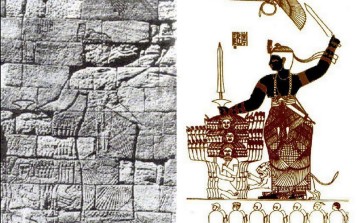
 sons. Instead, it was the husband who took up the position as consort. It is from the period of Kandake rule that we have a significant collection of art and inscriptions that depict the nature of their authority. In these the queen often towers, sometimes in the throes of smiting her enemy. In others, her hands are lifted in religious devotion. In all of them, she is the central or only theme of the work. If husbands appeared at all, they were small in stature compared to their queens, if a male appeared of any significance is was most often the Kandake’s son. Frequently, consorts went completely nameless in the record.
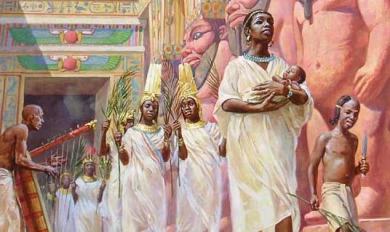 Kandake meant “queen mother,” revealing the preexisting importance of the position and offering an easily identifiable reason for the transition to singular female rule. The importance of women goes beyond the royal world, but includes a special regard for the role of wives and mothers in society. Many societies recognize motherhood as a crucial position yet it occupies a support role to male authority. In Kushite culture women were esteemed as vital monolithic entities that were active in both domestic and public worlds. Further, roles were fluid particularly when it came to power. Female roles within society embodied strength, an attribute needed for ruling a kingdom.
 women were known to arm themselves in everyday life, so the appearance of a queen a the helm of a military effort is not surprising. According to Roman accounts, “the Candace
 images of strong capable bodies. UNESCO describes a relief of Shanakdakhete, the first known true queen, as a women with, “a wide and powerful body adorned with many jewels…these traits which combine the promise of fertility and the exterior signs of wealth, symbolize prosperity and power.”
 Unbound